The Bilby

So what is Nature's Wonderland's animal mascot?

Well, it's a Bilby!

The Bilby, Macrotis lagotis, is an Australian species of nocturnal omnivorous animal in the Peramelemorphia order. The common name Bilby usually refers to Macrotis lagotis, but is distinguished from Macrotis leucura (the Lesser Bilby) that became extinct in the 1950s by the name Greater Bilby. It is also referred to as the dalgyte or pinkie and occasionally the'Rabbit-Eared Bandicoot. The Greater Bilby lives in arid areas of Central Australiaand is an important part of traditional indigenous culture in the deserts of Central Australia. The large rabbit like ears of the Greater Bilby have also made it a popular Australian icon at Easter. Sadly, through habitat loss and competition with introduced animals, the number of these small mammals has dramatically reduced over the last 100 years.

At first glance many people guess the Bilby to be a rabbit, and then others believe it is some sort of mouse, but neither is true! The Bilby is actually a marsupial that is most closely related to the bandicoot. The meaning of the world in an Aboriginal language is "long nosed rat" indicating that more than one person along the way has confused this animal with others, as it really is quite peculiar looking! In some areas of the world Bilbies are known as pinkies.

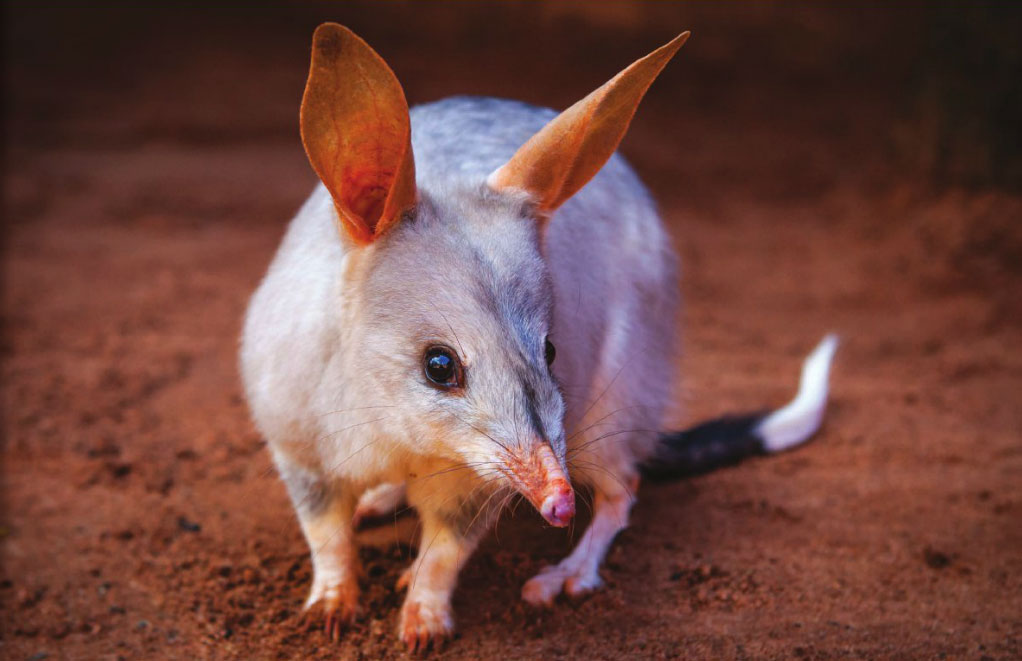
Bilbies are quite interesting to look at, to say the least. They have a pointy muzzle that is not unlike a rat and very long ears, quite like a rabbit. The species usually measures about 29-55 centimetres in length and they have somewhat long tails, big ears, and very soft fur. Their large ears allow them to have extraordinary hearing.

There used to be two different types of Bilbies in Australia, but one of them has been extinct since the 1950s with the other being available in limited numbers. The loss of the animals is due in large part to habitat loss and just a natural food chain, as the species is in competition for their place in the food chain with a lot of other animals. There is currently a protective plan in place that involves breeding Bilbies in captivity, closely monitoring wild populations, and helping to move the species back into areas where they once lived.

Characteristics
Bilbies have the characteristics of long bandicoot muzzle and very long ears. Compared to bandicoots, they have a longer tail, bigger ears, and softer, silky fur. The size of their ears allows them to have better hearing as well. At 1 to 2.4 kilograms (2.2 to 5.3 lb), the male is about the same size as a rabbit, although male animals in good condition have been known to grow up to 3.7 kilograms (8.2 lb) in captivity. The female is smaller, and weighs around 0.8 to 1.1 kilograms (1.8 to 2.4 lb). The Greater Bilby has an excellent sense of smell and sharp hearing. Its fur is blue-grey with patches of tan and it is very soft. The tail is black and white with a distinct crest. The Greater Bilby has strong forelimbs and thick claws, which it uses to dig for food and make burrows.

Unlike bandicoots, they are excellent burrowers and build extensive tunnel systems with their strong forelimbs and well-developed claws. The female Bilby's pouch faces backwards, which prevents her pouch from getting filled with dirt while she is digging.

Bilbies have a very short gestation period of about 12–14 days, one of the shortest among mammals.

Habitat
Once widespread in arid, semi-arid and relatively fertile areas, the Bilby is now restricted to arid wastelands and remains endangered. It makes its home in a burrow that spirals down, making it hard for its predators to get in. The Bilby prefers arid habitats because of the Spinifex grass and the acacia shrubs.

The Bilby is an animal that likes to burrow and these animals create their own system of intricate tunnels. A bilby typically makes a number of burrows within its home range, up to about a dozen, and moves between them, using them for shelter both from predators and the heat of the day.

This species is generally only seen out and about during the night time hours. Generally the Bilby will not come out of its burrow until an hour after the sun has set and will go back down into their burrows at least an hour before the sun rises. Many conditions are known to keep the Bilby in all day and night and these include strong winds, heavy rains, and even a full moon.

Diet
The Bilby is quite impressive as it does not need to drink water to stay alive; instead it gets all of the moisture that it needs from what it eats. Their diet generally includes insect larvae, spiders, fruit, fungus, bulbs, and even small animals. The species finds their food by digging in the soil and then using their long tongues to pull the food from the ground.

Reproduction
The Bilby has a gestational period that is worth noting, and that is because it is one of the shortest gestational periods of all known mammals. From the onset, the gestational period of this mammal is just 12 to 14 days! The species will breed all year long and will have one to three young at a time. The babies remain in the mothers pouch for about 80 days and after this time they are only dependent on their mothers for about two weeks.

Conservation
Bilbies are slowly becoming endangered because of habitat loss and change as well as the competition with other animals. Feral cats pose a major threat to the Bilby's survival, and there is some competition between Bilbies and Rabbits for food. There is a national recovery plan being developed for saving these animals: this program includes breeding in captivity, monitoring populations, and re-establishing bilbies where they once lived. There have been reasonably successful moves to popularise the bilby as a native alternative to the Easter Bunny by selling chocolate Easter Bilbies (sometimes with a portion of the profits going to bilby protection and research). Reintroduction efforts have also begun, with a successful reintroduction into the Arid Recovery Reserve in South Australia in 2000, and plans underway for a reintroduction into Currawinya National Park in Queensland, with a recent success with six bilbies released into the feral-free sanctuary in early February 2006.

Successful reintroductions have also occurred onto Peron Peninsula in Western Australia as a part of  Western Shield. Successful reintroductions have also occurred on other conservation lands, including islands and the Australian Wildlife Conservancy's Scotia and Yookamurra Sanctuaries. There is a highly-successful bilby breeding program at Kanyana Wildlife Rehabilitation Centre, near Perth, Western Australia.

Etymology
The term bilby is a loan word from the Yuwaalaraay Aboriginal language of northern New South Wales, meaning long-nosed rat. It is known as dalgite in Western Australia, and the nickname pinkie is sometimes used in South Australia. The Wiradjuri of New South Wales also call it bilby.

Popular Culture
The bilby is a unique animal, and is well known within Australia. It has become a popular native alternative to the Easter Bunny, known as the Easter Bilby. A National Bilby Day is held in Australia on the 2nd Sunday in September to raise funds for conservation projects.

References: Wikipedia, It's Nature